
Play School in Wave City: 8 Powerful Social Skills
A Safe, Happy and nurturing space for your Child’s Bright Future
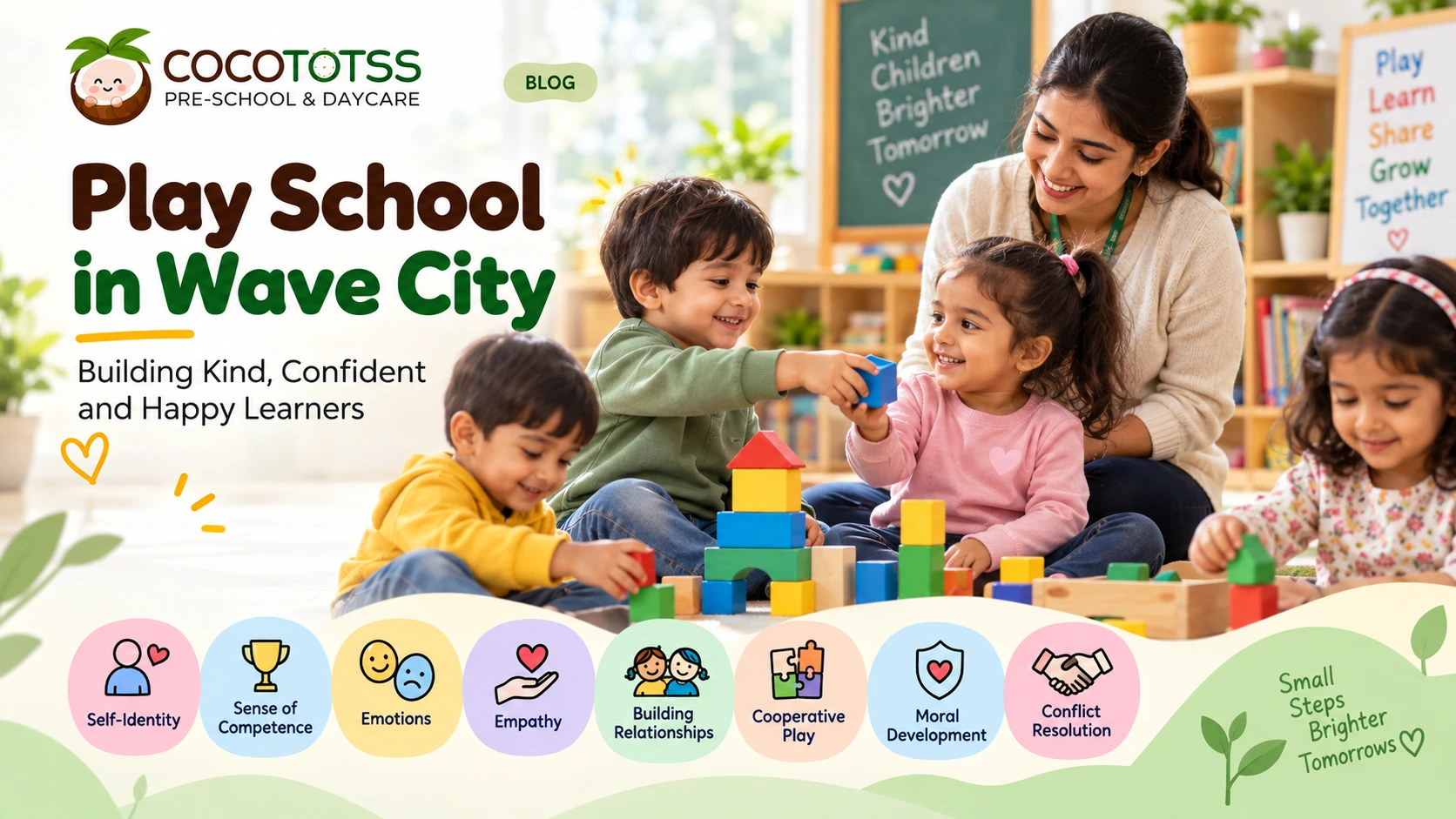
Finding the right Play school in Wave City is about more than choosing a place where children can play, learn letters and numbers, or prepare for the next class. The early years are also an important time for children to understand themselves, express feelings, make friends, cooperate with others and learn how to handle everyday situations.
At CocoTotss Preschool & Daycare, social and emotional development is an important part of our curriculum. We create a caring environment where children can develop confidence, empathy, emotional awareness and positive relationships through age-appropriate activities, play and everyday interactions.
Our Social & Emotional Development curriculum focuses on:
- Self-Identity
- Sense of Competence
- Emotions
- Empathy
- Building Relationships
- Cooperative Play
- Moral Development
- Conflict Resolution
These areas work together to help children become confident, caring and responsible learners.
The National Curriculum Framework for the Foundational Stage also recognizes socio-emotional and ethical development as an important part of early childhood education. It describes children as social beings who learn through observation, imitation, collaboration and concrete experiences.
What Is Social & Emotional Development?
Social and emotional development is the process through which children learn about themselves and understand how to interact with other people.
For a young child, this learning can happen through very simple experiences.
A child may learn to say:
“I am happy.”
Another child may learn:
“Can I play with you?”
A child may learn to wait for a turn, share a toy, ask for help or comfort a friend.
These may seem like small moments, but they are important building blocks for healthy relationships and confident learning.
A quality Play School Wave City environment should therefore give children opportunities to interact, communicate, explore feelings and practice social skills every day.
At CocoTotss, these skills are developed naturally through classroom routines, play, conversations, storytelling, group activities and teacher guidance.
Why Social & Emotional Learning Matters in Early Childhood
Children cannot learn effectively when they do not feel safe, comfortable or connected.
A child who feels understood is more likely to participate.
A child who feels confident is more willing to try something new.
A child who knows how to communicate their feelings may find it easier to ask for help.
A child who understands other people’s feelings can begin to develop empathy.
This is why early education should support the whole child.
The National Curriculum Framework for Foundational Stage identifies socio-emotional-ethical development as one of the important developmental areas and emphasizes play, activity, exploration, collaboration and social capacities in foundational education.
At CocoTotss, we bring these ideas into the daily classroom experience.
Our Social & Emotional Development Curriculum
Our curriculum is designed to help children gradually understand themselves, connect with others and manage everyday social situations.
Let’s look at the key areas.
Self-Identity: Helping Children Understand Who They Are
Self-identity is a child’s growing understanding of who they are.
At an early age, children begin to recognize:
- Their name
- Their likes and dislikes
- Their family
- Their interests
- Their abilities
- Their feelings
- Their personal choices
A child may say:
“I like drawing.”
Another child may say:
“I can build a tower.”
These simple statements show a growing sense of identity.
At CocoTotss, children are encouraged to express their ideas and preferences in age-appropriate ways.
Teachers can ask simple questions such as:
- “What do you like?”
- “Which colour do you want?”
- “What would you like to play?”
- “Who is in your family?”
- “What did you enjoy today?”
Such conversations help children understand that they are unique individuals with their own thoughts, interests and feelings.
For parents searching for a Play School in wave city ghaziabad, this type of child-centred environment can be an important factor to consider.
Sense of Competence: “I Can Do It”
Young children need opportunities to experience success.
Sense of competence means developing the feeling that:
“I can try.”
“I can learn.”
“I can do this.”
This does not mean children need to succeed at everything immediately.
In fact, trying, making mistakes and trying again are valuable parts of learning.
At CocoTotss, teachers can encourage children to attempt age-appropriate tasks independently.
For example:
- Completing a simple puzzle
- Building with blocks
- Putting away toys
- Choosing an activity
- Carrying their belongings
- Joining a group activity
- Completing a simple art task
When children experience small successes, they can begin to develop confidence in their own abilities.
Teachers support this process by giving encouragement without doing everything for the child.
This approach helps create a positive learning attitude.
Emotions: Learning to Understand Feelings
Young children experience many emotions.
They may feel:
- Happy
- Sad
- Excited
- Angry
- Worried
- Frustrated
- Proud
- Nervous
However, knowing what they feel and expressing it clearly can take time.
A child may cry because they are frustrated but may not yet know how to explain the reason.
This is where adults can help.
Instead of simply saying “Don’t cry,” a teacher can acknowledge the feeling and help the child find words for it.
For example:
“You look upset because the toy is not working.”
This helps connect the emotion with the situation.
Over time, children can learn that feelings are normal and that they can communicate them in healthy ways.
At CocoTotss, emotional awareness is part of creating a caring classroom environment.
Empathy: Understanding Other People
Empathy means beginning to understand how another person may feel.
For young children, empathy develops gradually.
A child may notice that a friend is crying.
The teacher might ask:
“How do you think your friend feels?”
The child may respond:
“Sad.”
Then the teacher can encourage a caring response:
“What could we do to help?”
The child might offer a toy, sit beside the friend or ask if they are okay.
These small experiences help children understand that other people have feelings too.
Empathy is not something children learn from a single lesson.
It grows through repeated experiences of kindness, cooperation, conversation and positive relationships.
Building Relationships: Learning to Make Friends
Making friends is an important part of the preschool experience.
Children learn many social skills while interacting with classmates.
They learn how to:
- Say hello
- Introduce themselves
- Start a conversation
- Share space
- Take turns
- Listen
- Ask questions
- Join a game
- Invite another child to play
- Respond to others
At CocoTotss, classroom activities provide opportunities for children to interact with their peers.
Group storytelling, music, art, building activities and pretend play can create natural opportunities for children to communicate and work together.
A supportive teacher helps children understand positive ways to interact.
This is particularly valuable for children who are experiencing a structured group environment for the first time.
Cooperative Play: Learning Together
Play is a powerful way for young children to practice social skills.
When children play together, they may need to share materials, decide what game to play and take turns.
For example, three children may want to build a large block structure.
They may need to decide:
Who will build the base?
Who will bring the blocks?
Who will add the top?
This simple activity can encourage:
- Communication
- Planning
- Cooperation
- Turn-taking
- Problem-solving
- Patience
- Listening
The National Curriculum Framework emphasizes play and activity as primary ways of learning and development and highlights collaboration and cooperation as important social capacities.
That makes cooperative play an important part of a strong early learning environment.
Moral Development: Learning Right from Wrong
Moral development begins with everyday experiences.
Young children gradually learn ideas such as:
- Being kind
- Telling the truth
- Taking care of belongings
- Helping others
- Following simple rules
- Respecting others
- Waiting for a turn
- Saying sorry
- Saying thank you
At preschool, these lessons do not need to be taught through long lectures.
They can be part of everyday classroom life.
If a child accidentally damages another child’s work, the teacher can help both children understand what happened and think about how to respond.
If a child helps another child, the teacher can recognize the positive behaviour.
Over time, children begin to understand that their actions affect other people.
Conflict Resolution: Learning to Handle Small Problems
Children will sometimes disagree.
Two children may want the same toy.
One child may not want to share.
Another child may feel left out of a game.
These situations are normal parts of growing up.
Instead of avoiding every disagreement, teachers can use these moments as learning opportunities.
Children can gradually learn to:
- Explain what happened.
- Listen to the other person.
- Identify how each person feels.
- Think about possible solutions.
- Choose a fair solution.
- Try again.
For young children, this process will always need adult support.
The goal is not to expect a preschool child to solve every disagreement alone.
The goal is to give them simple tools for handling social situations.
How Play Supports Emotional Development
Play allows children to express ideas and feelings in a natural way.
Pretend play is especially useful.
A child may pretend to be:
- A doctor
- A parent
- A teacher
- A shopkeeper
- A chef
- A firefighter
During pretend play, children can explore different roles and situations.
They can practice conversations, cooperation and decision-making.
For example, one child may pretend to be a doctor while another is the patient.
The children have to communicate:
“Where does it hurt?”
“You need to rest.”
“Here is your medicine.”
The activity is playful, but it also supports communication and social understanding.
This is one reason play-based learning is central to early childhood education. Government guidance on the Foundational Stage emphasizes play-based, activity-based and inquiry-based learning, alongside social capacities, teamwork and cooperation.
The Role of Teachers in Social & Emotional Development
Teachers play an important role in creating a positive classroom culture.
Children watch adults closely.
They notice how teachers speak, listen, respond to problems and treat other people.
A caring teacher can model:
- Respect
- Patience
- Kindness
- Listening
- Cooperation
- Calm communication
- Problem-solving
Teachers can also help children put their feelings into words.
For example:
Instead of:
“Stop crying.”
A supportive response may be:
“I can see that you are upset. Would you like to tell me what happened?”
This gives the child an opportunity to communicate.
Over time, such interactions can help children develop better emotional awareness.
Creating a Caring Environment at CocoTotss
CocoTotss Preschool & Daycare describes its approach as combining play, activities, exploration, creativity, social interaction and age-appropriate learning. The school also emphasizes confidence, independence and holistic development.
Our curriculum includes Social & Emotional Development because we believe early learning should support more than academic preparation.
Children need opportunities to:
- Feel safe
- Build confidence
- Make friends
- Express emotions
- Cooperate
- Explore
- Ask for help
- Solve simple problems
- Learn kindness
- Become more independent
Our campus is located in Aditya World City, Ghaziabad, and the school’s current program information lists Play Group, Pre-Nursery, Nursery, LKG, UKG and daycare options.
What Makes a Good Play School?
Parents searching for the Best Play School in wave city may find many choices online.
But the word “best” should not be based only on advertisements.
Parents should visit schools and consider what the environment is actually like.
Look at:
1. Teacher-Child Interaction
Do teachers listen to children and speak to them respectfully?
2. Classroom Environment
Is the classroom welcoming, clean and suitable for young children?
3. Learning Approach
Does the school provide opportunities for play, exploration and hands-on activities?
4. Social Development
Are children encouraged to communicate, cooperate and build friendships?
5. Safety
Does the school have clear safety and supervision practices?
6. Parent Communication
Does the school keep parents informed about their child’s experience?
7. Activities
Are children given opportunities for art, music, movement, storytelling and outdoor play?
8. Emotional Well-Being
Does the school recognize children’s feelings and provide a caring environment?
These points can help parents make a more informed decision.
Play School in Wave City Near Me: What Parents Should Consider
When parents search for Play school in wave city near me, distance is naturally an important factor.
But location should not be the only consideration.
A school may be close to home, but parents should also understand:
- The curriculum
- Teacher interaction
- Safety measures
- Classroom facilities
- Play areas
- Daily routines
- Parent communication
- Transport availability
- Daycare options
- Fee structure
Visiting the school can provide information that a search result cannot.
CocoTotss itself recommends that parents visit the campus and consider teacher interaction, classroom environment, safety, cleanliness, curriculum, play facilities and how comfortable their child feels.
Supporting Social & Emotional Learning at Home
Parents can continue the same learning at home.
You do not need complicated activities.
Simple everyday moments can teach important lessons.
Talk About Feelings
Ask:
“How did that make you feel?”
“What made you happy today?”
Encourage Sharing
When children play with siblings or friends, encourage them to take turns.
Let Children Make Small Choices
Ask:
“Would you like the red cup or the blue cup?”
Simple choices can help children develop independence.
Read Stories
Stories can help children talk about characters, emotions and choices.
Ask:
“Why do you think the character was sad?”
Encourage Kindness
Notice positive actions.
Say:
“That was kind of you to help your friend.”
Help Children Solve Small Problems
Instead of immediately solving every problem, ask:
“What could we try?”
This gives children a chance to think.
CocoTotss Curriculum and Holistic Development
Social & Emotional Development is one part of the broader CocoTotss curriculum.
The school’s current curriculum also includes:
- Approaches to Learning
- Social & Emotional Development
- Physical Development & Health
- Language, Literacy & Communication
- Mathematics
- Science & Technology
- Creative Arts
- Social Studies
This broader approach reflects the idea that young children develop across several connected areas rather than through academic subjects alone. The National Curriculum Framework similarly identifies physical, cognitive, socio-emotional-ethical, cultural/artistic and communication-related development as important goals for the Foundational Stage.
You can explore the full CocoTotss Programs and learn more about the school’s approach to early education.
Cocototss Wave City Fees Structure
Parents often search for the Cocototss Wave City fees structure before planning a school visit.
Preschool fees can vary depending on the child’s program, session, daycare requirements, transport and other selected services.
CocoTotss’ current FAQ states that parents should contact the admissions team for the latest fee information rather than relying on outdated online figures.
For the latest information, parents can contact CocoTotss directly.
Phone: +91 9810768540
Email: admission@cocototss.com
Cocototss Wave City Reviews
Parents searching for Cocototss Wave City reviews may find online reviews useful when researching a preschool.
However, reviews should be considered along with an actual school visit.
Parents can look at reviews for general experiences, then visit the campus to see:
- How teachers interact with children
- How children use the learning spaces
- How the classrooms are maintained
- How the school communicates with parents
- Whether the environment feels comfortable for their child
A personal visit allows parents to make their own assessment.
School in Wave City, Ghaziabad: Finding the Right Early Learning Environment
Families searching for a School in Wave City, Ghaziabad may be comparing preschools, play schools, daycare centres and early learning programs.
For younger children, the environment should be designed around their developmental needs.
A good early learning experience should provide space for:
Play + Learning + Communication + Movement + Creativity + Social Interaction
At CocoTotss, children are encouraged to learn through activities, exploration, interaction and play.
The current Play Group program is designed for children around 1–2 years and uses sensory play, music, movement, stories and interactive games to support early communication and social skills.
Why Social & Emotional Development Builds Strong Foundations
Children do not suddenly become confident and socially skilled when they enter primary school.
These abilities develop over time.
The early years provide many opportunities to practice them.
A child who learns to express feelings can gradually communicate more clearly.
A child who practices cooperation can become more comfortable working with others.
A child who learns empathy can begin to understand different perspectives.
A child who experiences positive relationships can develop trust and confidence.
This is why Social & Emotional Development is an important part of our curriculum.
Frequently Asked Questions (FAQ) AboutPlay School in Wave City
What is Social & Emotional Development in preschool?
Children spend a large part of their early learning experience interacting with teachers and classmates. Social development helps them communicate, cooperate, make friends and participate confidently in group activities.
The curriculum includes Self-Identity, Sense of Competence, Emotions, Empathy, Building Relationships, Cooperative Play, Moral Development and Conflict Resolution.
Play gives children opportunities to communicate, pretend, cooperate, solve problems and express ideas and feelings in a natural way.
Parents can talk about feelings, encourage sharing, read stories, offer simple choices, recognize kind behaviour and help children think through small problems.
CocoTotss Preschool & Daycare is located at Plot No- GH-6, Nursery School Building, Aditya World City, Sahapur Bamheta, Ghaziabad, Uttar Pradesh. The current main website lists this location as part of its contact information.
The current CocoTots contact number is +91 9810768540.
Parents can contact the CocoTots admissions team for the current program, daycare, transport and fee information because charges can vary by requirements.
Choose a Caring Start for Your Child
Choosing a Play school in Wave City is an important step in your child’s early learning journey.
The right environment should give children more than worksheets and classroom routines. It should give them opportunities to explore who they are, understand their feelings, build friendships, cooperate with others and develop confidence.
At CocoTots Preschool & Daycare, our Social & Emotional Development curriculum focuses on Self-Identity, Sense of Competence, Emotions, Empathy, Building Relationships, Cooperative Play, Moral Development and Conflict Resolution.
Through play, conversation, activities and caring relationships, children can gradually develop the social and emotional skills they need for their next stage of learning.
For families searching for Play School in wave city ghaziabad, Play school in wave city near me, or Cocototss Pre school Ghaziabad, CocoTots provides a child-focused environment where children can learn, play, explore and grow.
Visit CocoTotss Preschool & Daycare in Aditya World City, Ghaziabad to understand the learning environment and discuss your child’s admission, program and daycare requirements.
Recent Post
-
 06 Oct 2026Playschool & Day Care in Wave City: 10 Powerful Skills
-
 03 Oct 2026Play school in Wave City: 5 Powerful Ways to Grow
-
22 Sep 2026Play School in Wave City: 8 Powerful Social Skills
-
 12 Sep 2026Pre Nursery in Wave City: Inspiring Curious & Independent Learners
-
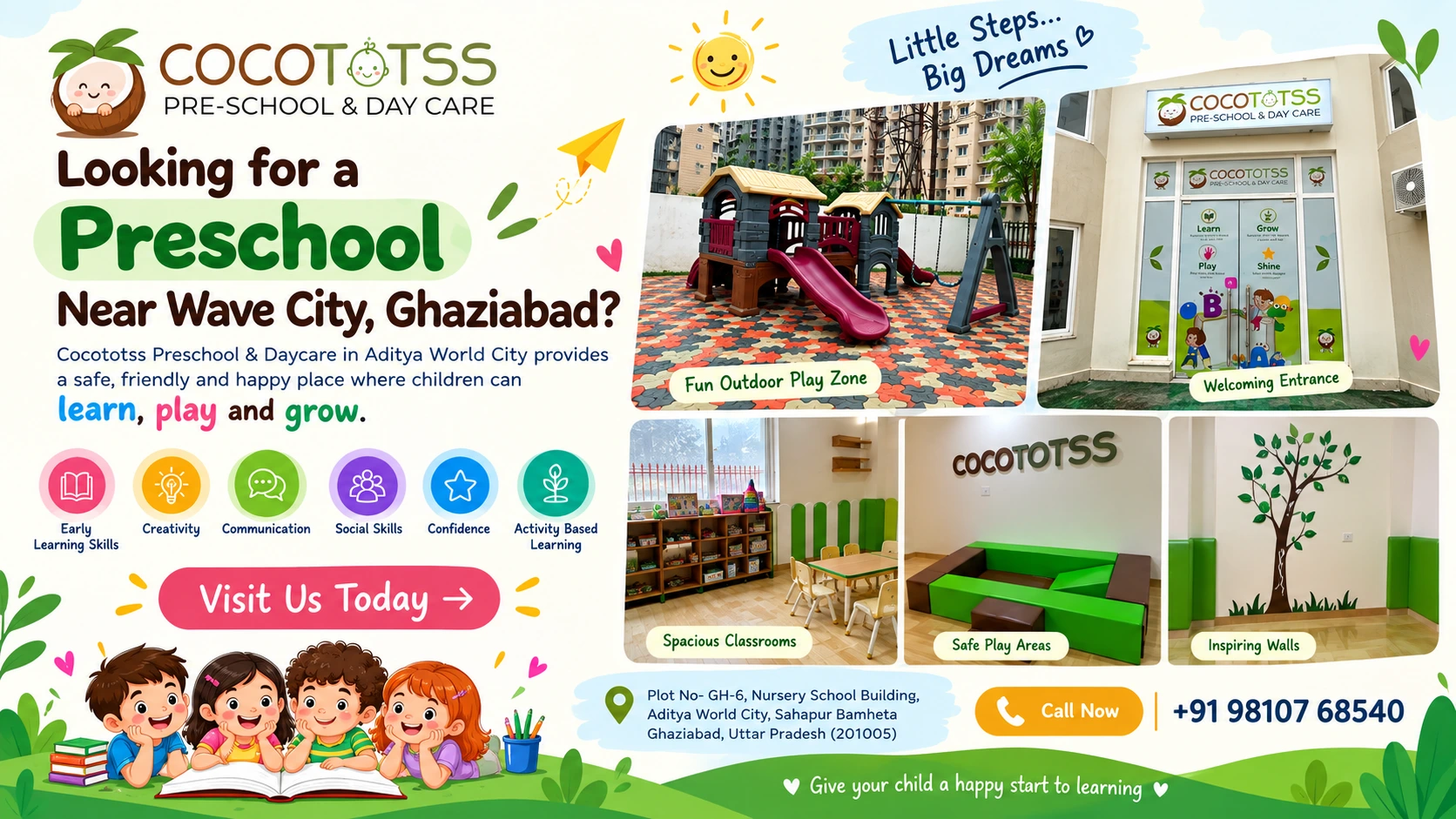 07 Sep 2026Preschool in Wave City
Near By Area
- Preschool in Aditya World City
- Preschool in Wave city
- Daycare in Wave City
- Daycare in Aditya World City
- Play Group in Wave City
- Play Group in Aditya World City
- Pre-Nursery in Aditya World City
- Nursery in Aditya World City
- LKG in Aditya World City
- UKG in Aditya World City
Contact us at:
- 9810768540
- Addmission@cocototss.com
- Plot No- GH-6, Nursery School Building, Aditya World City, Sahapur Bamheta Ghaziabad, Uttar Pradesh (201005)

2 Responses