
Playschool & Day Care in Wave City: Helping Every Child Find Their Voice
A Safe, Happy and nurturing space for your Child’s Bright Future
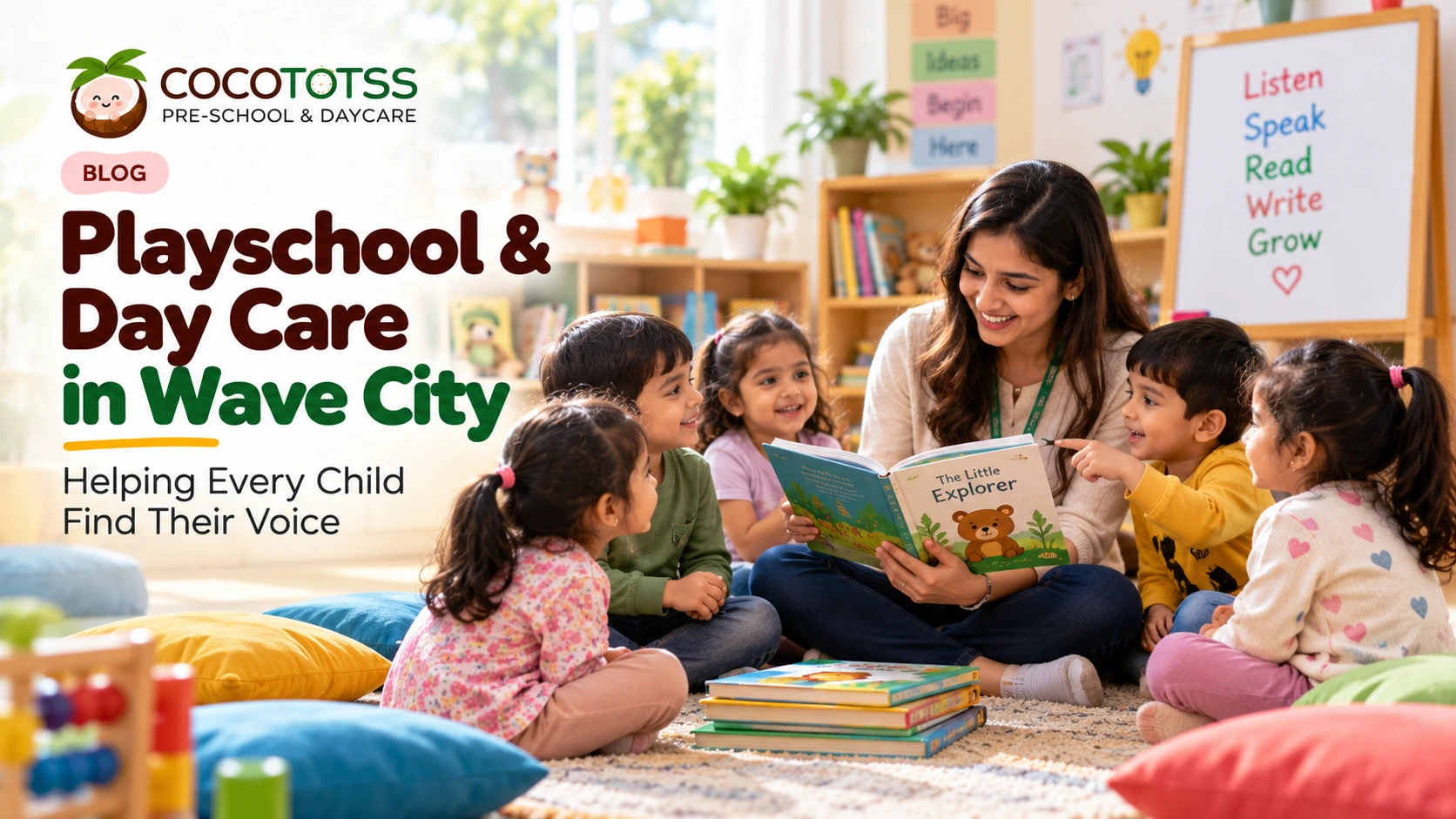
Choosing the right Playschool & Day Care in Wave City is an important decision for parents. In the early years, children are learning how to listen, speak, understand words, express ideas, enjoy stories, recognize sounds, look at books and communicate with the people around them.
At CocoTotss Preschool & Daycare, we believe that every child has a voice. Our language-rich learning environment gives children opportunities to listen, speak, read, write and communicate with confidence through stories, conversations, songs, phonics, books, games and interactive activities.
Our Language, Literacy & Communication curriculum focuses on ten connected areas:
- Comprehension
- Speaking
- Vocabulary
- Phonological Awareness
- Alphabetic Knowledge
- Reading
- Concepts About Print
- Book Knowledge
- Writing
- ELL / Dual Language Acquisition
These areas are not taught only through worksheets. Young children learn language best when they hear it, use it, enjoy it and connect it with real experiences.
The National Curriculum Framework for the Foundational Stage recognizes language and literacy as fundamental parts of education. It also emphasizes that strong oral language provides an important foundation for later literacy. NCERT
Why Language Matters in the Early Years
Language is one of the main ways children understand the world.
Before children can read a story themselves, they listen to stories.
Before they can write sentences, they hear words and use them while speaking.
Before they can explain a complex idea, they learn to name objects, describe experiences and ask questions.
This is why language development begins long before formal reading and writing.
A child saying:
“I want the red ball.”
is already using language to communicate a need.
A child saying:
“The dog is running.”
is using vocabulary and sentence structure.
A child asking:
“Why is the moon there?”
is using language to explore an idea.
These everyday conversations are valuable learning moments.
At CocoTotss, we create opportunities for children to communicate naturally throughout the day.
What Is Language, Literacy & Communication?
Language, literacy and communication are closely connected, but they are not exactly the same.
Language: Language helps children understand and express ideas through listening and speaking.
Communication: Communication is how children share thoughts, needs, feelings and information with other people.
Literacy: Literacy includes the skills children develop around books, sounds, reading, writing and understanding print.
A strong early learning program connects all three.
For example, during a story session, a child may:
- Listen to the teacher.
- Understand what is happening.
- Learn new words.
- Answer questions.
- Notice sounds.
- Look at pictures.
- Turn pages.
- Talk about characters.
- Predict what happens next.
- Later draw or write about the story.
One simple story can therefore support many learning areas.
Our Language, Literacy & Communication Curriculum
The CocoTotss curriculum is designed to provide children with meaningful opportunities to develop communication and early literacy skills.
The goal is not to rush children into formal academics.
The goal is to build a strong foundation.
Our ten focus areas help children gradually develop from active listeners into confident communicators and emerging readers and writers.
Comprehension: Understanding What Children Hear
Comprehension means understanding what we hear or read.
For young children, comprehension begins with listening.
When a teacher tells a story, children can learn to:
- Listen carefully.
- Understand simple ideas.
- Remember important details.
- Answer questions.
- Follow instructions.
- Connect events.
- Predict what might happen.
- Talk about characters and experiences.
For example, after reading a story about a lost puppy, a teacher might ask:
“Where did the puppy go?”
“Who helped the puppy?”
“How do you think the puppy felt?”
These simple questions encourage children to listen and think.
Comprehension can also develop through everyday classroom instructions.
A teacher may say:
“Please take your book, sit on the mat and open the first page.”
Following this instruction requires listening, understanding and remembering.
The National Curriculum Framework includes listening and comprehension within the foundational language competencies and encourages meaningful communication rather than learning language only through formal drills. NCERT
Speaking: Helping Children Express Their Ideas
Speaking is an important part of early learning.
Children need opportunities to talk.
They should feel comfortable sharing:
- Ideas
- Questions
- Feelings
- Experiences
- Stories
- Needs
- Opinions
At CocoTotss, teachers can encourage children to speak during circle time, storytelling, role play, group activities and everyday classroom conversations.
A teacher might ask:
“What did you do at home today?”
“What is your favourite toy?”
“What do you see outside?”
“What would you like to build?”
There may not always be one correct answer.
The purpose is to encourage children to use language.
A child who initially answers with one word may gradually begin using short sentences.
Over time, children can become more comfortable speaking in front of others.
Vocabulary: Giving Children More Words
Vocabulary is the collection of words a child understands and uses.
The more words children understand, the easier it becomes for them to describe the world around them.
Instead of only knowing:
“Big”
a child may learn:
- Huge
- Tall
- Wide
- Long
- Heavy
Instead of simply saying:
“Happy”
a child may learn:
- Excited
- Proud
- Cheerful
- Surprised
Vocabulary can grow naturally through conversations, books, songs, games and real experiences.
For example, a classroom activity about plants can introduce words such as:
- Leaf
- Stem
- Root
- Flower
- Seed
- Grow
The teacher can then use these words repeatedly during conversations and activities.
This helps children connect new words with things they can see and touch.
Phonological Awareness: Listening to Sounds in Words
Phonological awareness is the ability to notice and work with sounds in spoken language.
Young children can develop this skill through playful activities.
They may learn to:
- Listen for rhyming words.
- Clap syllables.
- Notice beginning sounds.
- Repeat sound patterns.
- Identify words that sound alike.
- Play with sounds in songs and rhymes.
For example:
Cat – Hat
Sun – Fun
Children can listen and notice that the words have similar ending sounds.
Songs, rhymes and rhythmic games can make this learning enjoyable.
The National Curriculum Framework includes listening to songs, rhymes and poems as part of foundational language development. NCERT
This is one reason songs and rhymes are useful in an early learning environment.
Alphabetic Knowledge: Connecting Letters and Sounds
Alphabetic knowledge involves learning about letters and their relationship with sounds.
Children may begin by recognizing familiar letters.
For example:
“This is A.”
They may then begin to notice that letters represent sounds.
Learning should be age-appropriate and enjoyable.
Instead of asking children to memorize long lists of letters, teachers can introduce letters through:
- Songs
- Picture cards
- Stories
- Letter games
- Matching activities
- Classroom displays
- Name recognition
- Hands-on activities
A child’s own name can be a meaningful starting point.
For example, a child may begin recognizing the first letter of their name on a classroom label.
This gives the letter a personal connection.
Reading: Building a Love for Books
Reading development begins before children can read independently.
A child sitting with a teacher and listening to a story is already participating in early literacy.
During shared reading, children can learn to:
- Hold books correctly.
- Turn pages.
- Look at pictures.
- Listen to stories.
- Identify characters.
- Talk about events.
- Predict what happens next.
- Retell familiar stories.
- Notice repeated words.
Reading should be enjoyable.
When children associate books with positive experiences, they can develop a natural interest in stories.
The NCF emphasizes the importance of language-rich environments and meaningful exposure to books and print during the Foundational Stage. NCERT
At CocoTotss, storytelling and books can become part of the child’s everyday learning experience.
Concepts About Print: Understanding How Books Work
Children need to discover that printed text carries meaning.
Before reading independently, they gradually learn concepts such as:
- A book has a front and back.
- Pages are turned in sequence.
- Pictures and words are connected.
- Written words communicate messages.
- Text follows a direction.
- Letters and words look different.
- Spaces separate words.
These ideas may seem obvious to adults, but they are new discoveries for young children.
A teacher can support this learning simply by pointing to words while reading.
For example:
“These are the words we are reading.”
“This is the title.”
“Let’s turn the page.”
A print-rich classroom can provide additional exposure.
The NCF specifically highlights the value of print-rich environments, including word labels, word walls, word cards and accessible classroom libraries. NCERT
Book Knowledge: Becoming Comfortable With Stories
Book knowledge goes beyond knowing how to hold a book.
Children can gradually learn:
- What an author does.
- What an illustrator does.
- How stories work.
- How pictures provide information.
- How characters behave.
- How stories have beginnings and endings.
- How books can answer questions.
Teachers can ask questions such as:
“What do you think this book is about?”
“Who is the main character?”
“What happened first?”
“What do you think will happen next?”
This turns reading into an interactive experience.
Children become active participants rather than passive listeners.
Writing: Helping Children Express Ideas on Paper
Writing begins long before children write full sentences.
Early writing can include:
- Scribbling
- Drawing
- Lines
- Shapes
- Marks
- Letter-like forms
- Writing familiar letters
- Writing their name
- Copying simple words
These early attempts are important.
When a child draws a picture and then explains:
“This is my house.”
the child is connecting an idea with a visual representation.
Later, children can begin adding letters and words.
Teachers can encourage this development without making writing stressful.
Simple activities can include:
- Drawing and labelling.
- Writing their name.
- Making greeting cards.
- Creating simple story pictures.
- Writing letters in sand.
- Using crayons and pencils.
- Making pretend shopping lists.
The aim is to help children understand that writing is a way to communicate.
ELL / Dual Language Acquisition: Supporting More Than One Language
India is a multilingual country.
Many children grow up hearing more than one language at home, in their neighbourhood or in their community.
This can be an important part of a child’s identity.
The National Curriculum Framework recognizes multilingualism as valuable and recommends meaningful exposure to children’s home languages while developing additional languages. It also says children should not be discouraged or made to feel ashamed of their home language. NCERT
At CocoTotss, children can benefit from a language environment where communication is encouraged and children can connect new words and ideas with experiences they already understand.
For example, if a child knows an object by its home-language name, the teacher can introduce the English word alongside it.
This creates a bridge between familiar knowledge and new learning.
Why a Language-Rich Environment Matters
A language-rich classroom gives children many chances to hear and use words.
This can happen through:
- Storytelling: Stories introduce vocabulary, characters, emotions and ideas.
- Conversations: Daily conversations help children practice speaking.
- Songs and Rhymes: Songs make sounds and words memorable.
- Role Play: Pretend play encourages communication.
- Picture Books: Books provide visual and language experiences.
- Group Activities: Children learn to listen and respond to others.
- Classroom Labels: Print around the classroom gives children natural exposure to written language.
- Questions: Open-ended questions encourage children to think and explain.
The goal is to make language part of the child’s entire day rather than limiting it to one lesson.
Play and Language Learning
Play and language work well together.
Imagine a pretend grocery shop.
Children can:
- Name foods.
- Ask for items.
- Count objects.
- Talk about prices.
- Take turns.
- Pretend to be customers.
- Pretend to be shopkeepers.
A simple play activity can therefore support:
Vocabulary + Speaking + Social Skills + Comprehension + Imagination
The NCF recommends play-based and activity-based approaches during the Foundational Stage and recognizes that children learn through meaningful experiences and interaction. NCERT
This is why a good Playschool & Day Care in Wave City should give children plenty of opportunities to communicate during play.
Storytelling: One of the Best Tools for Early Language
Storytelling is a powerful way to build language skills.
A story can introduce:
- New words
- Sentence patterns
- Characters
- Emotions
- Problems
- Solutions
- Events
- Imagination
Teachers can make storytelling interactive.
Instead of reading the entire story without stopping, they can ask:
“What do you think will happen?”
“Why is the character sad?”
“Where should the character go?”
“What would you do?”
These questions encourage children to listen, think and speak.
After the story, children might draw their favourite character or act out a scene.
This connects language with creative and social learning.
Songs, Rhymes and Music
Children naturally enjoy rhythm and repetition.
Songs and rhymes can help children hear:
- Repeated words
- Rhyming sounds
- Rhythm
- Sentence patterns
- New vocabulary
A familiar song also encourages participation.
Children may sing, clap, move or use gestures while learning.
This can make language learning memorable and enjoyable.
NCERT specifically identifies songs, rhymes and poems as valuable parts of early language development. NCERT
Communication Through Everyday Activities
Language learning does not have to happen only during formal lessons.
Everyday routines provide many opportunities.
Arrival
“Good morning. How are you today?”
Snack Time
“What fruit are you eating?”
Art
“What are you making?”
Outdoor Play
“Where are you going?”
Clean-Up
“Where should this toy go?”
Departure
“What did you enjoy today?”
These small conversations add up.
Children get repeated opportunities to listen, respond and use words.
Helping Shy Children Find Their Voice
Not every child speaks confidently in a group.
Some children need more time.
A caring teacher can support them without forcing them to speak before they are ready.
Teachers can begin with:
- One-to-one conversations.
- Small-group activities.
- Picture-based questions.
- Songs.
- Puppet play.
- Partner activities.
- Familiar stories.
For example, a child may first answer a teacher quietly.
Later, they may speak in a small group.
Eventually, they may feel comfortable speaking in front of the whole class.
The process should be gradual.
The goal is to build confidence, not pressure.
How Parents Can Support Language Development at Home
Parents play an important role in early language learning.
You do not need expensive learning materials.
Everyday conversations can make a difference.
Talk With Your Child
Ask questions and listen to the answer.
Instead of only asking:
“How was school?”
try:
“What made you smile today?”
“What did you build?”
“Who did you play with?”
Read Together
Spend a few minutes reading every day.
Let your child turn pages and talk about pictures.
You do not need to finish every story.
The conversation around the book is valuable too.
Introduce New Words
When your child sees something new, name it.
If you see a butterfly, you can talk about:
- Wings
- Colours
- Flying
- Garden
- Flowers
This builds vocabulary naturally.
Encourage Storytelling
Ask your child to tell you what happened during the day.
Let them speak in their own way.
Do not correct every small mistake.
First, encourage communication.
Support Home Languages
If your family uses Hindi or another language at home, continue using it naturally.
A strong home-language foundation can support communication and can provide a bridge when children learn another language.
NCERT emphasizes the importance of children’s home languages in early learning and says they should be respected and encouraged. NCERT
Choosing a Playschool & Day Care in Wave City
Parents searching for Play School in wave city ghaziabad may find many options.
But choosing a preschool should involve more than comparing advertisements.
Consider the learning environment.
- Language Environment: Do teachers talk with children regularly?
- Books: Are books easily available?
- Storytelling: Are stories and songs part of the daily routine?
- Communication: Are children encouraged to ask questions?
- Classroom Displays: Does the classroom have age-appropriate print?
- Play: Do children communicate while playing?
- Individual Attention: Do teachers notice each child’s communication needs?
- Parent Partnership: Does the school communicate with parents?
These factors can help families make a better decision.
What Makes CocoTotss Different?
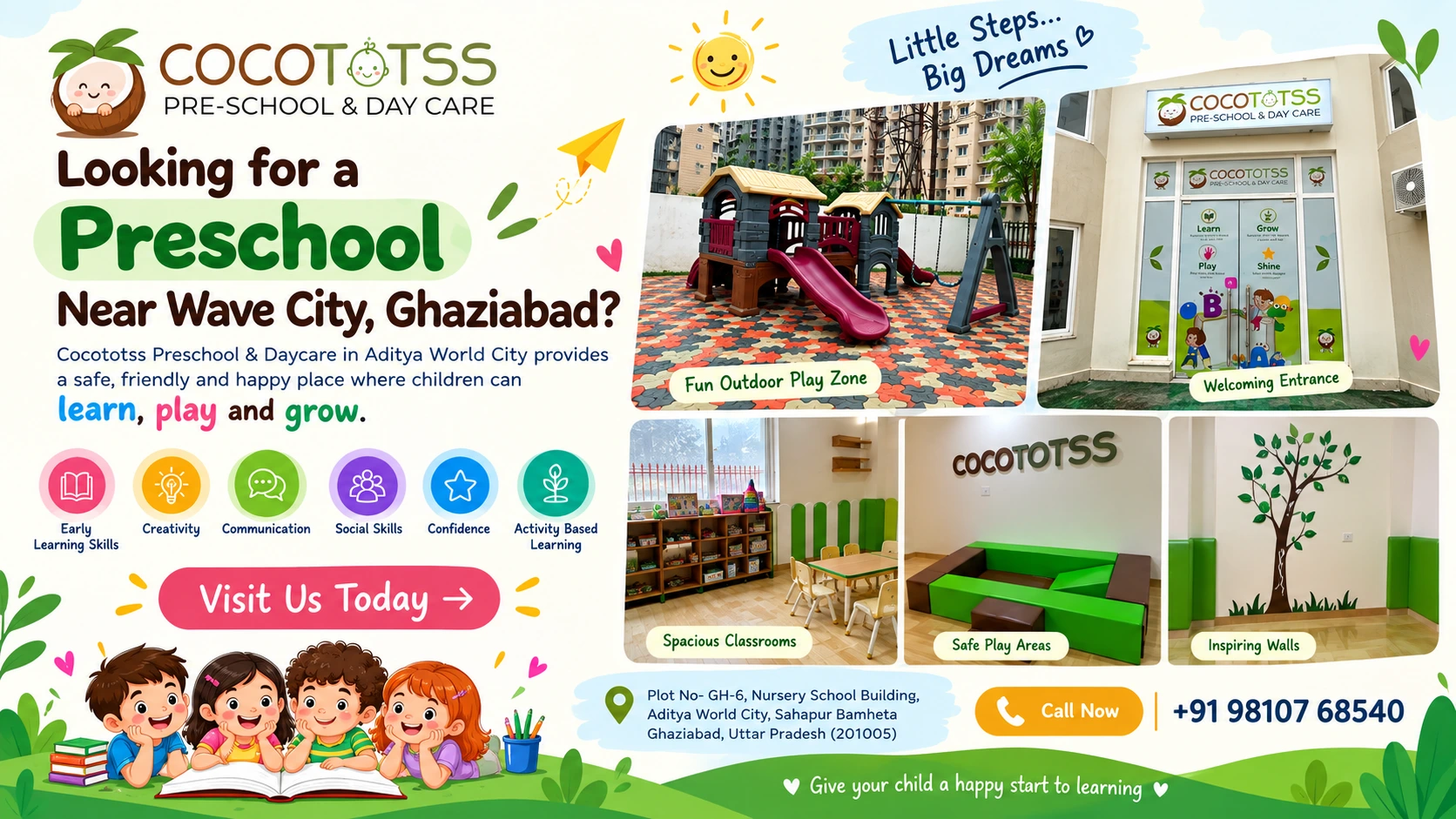
CocoTotss Preschool & Daycare is located in Aditya World City, Ghaziabad, and its current website describes its learning approach as play-based, activity-based and experiential. CocoTotss Preschool & Day Care
The school’s curriculum includes Language, Literacy & Communication alongside Social & Emotional Development, Physical Development & Health, Mathematics, Science & Technology, Creative Arts, Social Studies and Approaches to Learning. CocoTotss Preschool & Day Care
This creates opportunities for children to develop language while also building other important skills.
A storytelling activity can involve language and emotional development.
A block activity can involve vocabulary, mathematics and social communication.
An art activity can involve fine-motor development, language and creativity.
Learning is therefore connected rather than divided into isolated subjects.
Playschool & Day Care in Wave City for Working Parents
For working parents, finding a school that offers both early learning and daycare can make daily life easier.
CocoTotss offers preschool and daycare services, with current program information covering early learning stages and flexible daycare options. CocoTotss Preschool & Day Care
For parents looking for a Play school in wave city near me, combining preschool and daycare can also provide continuity in the child’s daily environment.
However, parents should ask the admissions team about:
- Current daycare timings
- Program availability
- Meals
- Activities
- Transport
- Fees
- Pickup and drop arrangements
- Admission availability
These details can change, so it is better to confirm them directly with the school.
Play School Near Me Ghaziabad With Fees
Parents often search phrases such as Play school near me ghaziabad with fees when comparing schools.
Fee comparison is useful, but parents should look at what is included.
Ask whether the quoted fee covers:
- Preschool program
- Daycare
- Meals
- Transport
- Activity materials
- Events
- Other services
CocoTotss’ FAQ advises parents to contact the school for current fee information because fees can depend on the selected program and services. CocoTotss Preschool & Day Care
For the latest Cocototss play school fees, parents can contact:
Phone: +91 9810768540
Email: admission@cocototss.com
Cocotots Play School Near Me
When parents search for Cocototss play school near me, they are often looking for location, programs, admissions, fees and school facilities.
CocoTotss Preschool & Daycare is located in Wave City, Ghaziabad, and its current FAQ says the campus serves families living in Wave City and surrounding areas. CocoTotss Preschool & Day Care
Parents can visit the campus to understand:
- Classroom environment
- Teaching approach
- Learning resources
- Outdoor activities
- Teacher interaction
- Daycare arrangements
A school visit is often the best way to decide whether the environment feels right for your child.
Best Play School in Wave City: What Should “Best” Mean?
Many parents search for the Best Play School in wave city.
But “best” should not simply mean the school with the biggest advertisement.
For one family, location may be most important.
For another, daycare may matter more.
Another family may focus on curriculum, safety or teacher-child interaction.
Instead of choosing based only on a ranking, look for a school that matches your child’s needs.
A good preschool should provide a safe, caring and stimulating environment where children can learn through meaningful experiences.
CocoTotss’ About page describes its Wave City campus as a warm learning environment with bright rooms, toys and caring teachers. CocoTotss Preschool & Day Care
Play School Near Me Ghaziabad CBSE: What Parents Should Know
Parents sometimes search Play school near me ghaziabad cbse when they are planning their child’s complete education journey.
It is important to understand that preschool and formal school are different stages.
For early childhood, parents should first look at:
- Age-appropriate curriculum
- Play-based learning
- Language development
- Social development
- Physical development
- Safety
- Teacher interaction
- Emotional well-being
A strong preschool foundation can help children develop habits that support later school learning.
The National Curriculum Framework for the Foundational Stage specifically promotes play-based and developmentally appropriate learning during these early years. NCERT
Top 10 Play Schools in Ghaziabad: Look Beyond a List
Searches such as Top 10 play schools in Ghaziabad can be useful for discovering options, but online lists may not tell parents everything they need to know.
Before selecting a school, compare schools based on your family’s actual needs.
Visit the campus.
Meet the teachers.
Ask questions.
Observe how children are treated.
Look at the learning environment.
Understand the curriculum.
Ask about fees and daycare.
This will give you more useful information than a generic ranking.
Building Strong Communication for School Readiness
Language skills support many parts of a child’s future learning.
A child needs language to:
- Ask for help.
- Understand instructions.
- Talk with teachers.
- Make friends.
- Answer questions.
- Share ideas.
- Understand stories.
- Learn new concepts.
- Express feelings.
This is why language development is not only about learning the alphabet.
It is about giving children the ability to understand and communicate.
The NCF describes language and literacy development as fundamental aims of education and highlights the strong connection between language and cognition. NCERT
Frequently Asked Questions (FAQ) AboutPlay School in Wave City
It means helping children develop listening, speaking, vocabulary, sound awareness, early reading, writing and communication skills through age-appropriate experiences.
Early language helps children communicate their needs, understand instructions, express ideas, build relationships and develop foundations for later literacy.
Storytelling can develop listening, comprehension, vocabulary, imagination and speaking skills.
CocoTotss creates a language-rich environment, while the broader educational approach recognizes the value of children's home languages and multilingual development. The NCF encourages respectful use of children's home languages and meaningful exposure to additional languages. NCERT
The current CocoTotss FAQ lists programs from approximately 18 months to 6 years, including Toddler, Playgroup, Nursery, Junior KG and Senior KG, along with daycare options. CocoTotss Preschool & Day Care
CocoTotss Preschool & Daycare is located in Wave City, Ghaziabad, Uttar Pradesh. CocoTotss Preschool & Day Care
The current contact number listed for CocoTotss is +91 9810768540. CocoTotss Preschool & Day Care
Parents can contact the admissions team directly for current fees, program availability, daycare and other services.
Look at the curriculum, teachers, safety, classroom environment, language activities, play opportunities, parent communication, daycare options and overall comfort of your child.
Helping Every Child Find Their Voice
A child’s voice is more than the words they speak.
It is their ability to ask a question.
It is their confidence to share an idea.
It is the story they tell about their day.
It is the song they sing.
It is the picture they draw and explain.
It is the question they ask when they are curious.
It is the courage to speak with a teacher or make a new friend.
At CocoTotss, our Language, Literacy & Communication curriculum is designed to support these everyday moments.
Through Comprehension, Speaking, Vocabulary, Phonological Awareness, Alphabetic Knowledge, Reading, Concepts About Print, Book Knowledge, Writing and ELL/Dual Language Acquisition, children get opportunities to develop the foundations of effective communication and early literacy.
For families searching for Playschool & Day Care in Wave City, Play School in wave city ghaziabad, Play School in wave city near me, Best Play School in wave city, or Cocototss play school near me, CocoTotss offers a caring environment where children can learn through play, conversation, stories and meaningful experiences.
The aim is simple:
Listen. Speak. Explore. Read. Write. Communicate. Grow.
And most importantly, find their voice.
Recent Post
-
06 Oct 2026Playschool & Day Care in Wave City: 10 Powerful Skills
-
 03 Oct 2026Play school in Wave City: 5 Powerful Ways to Grow
-
 22 Sep 2026Play School in Wave City: 8 Powerful Social Skills
-
 12 Sep 2026Pre Nursery in Wave City: Inspiring Curious & Independent Learners
-
 07 Sep 2026Preschool in Wave City
Near By Area
- Preschool in Aditya World City
- Preschool in Wave city
- Daycare in Wave City
- Daycare in Aditya World City
- Play Group in Wave City
- Play Group in Aditya World City
- Pre-Nursery in Aditya World City
- Nursery in Aditya World City
- LKG in Aditya World City
- UKG in Aditya World City
Contact us at:
- 9810768540
- Addmission@cocototss.com
- Plot No- GH-6, Nursery School Building, Aditya World City, Sahapur Bamheta Ghaziabad, Uttar Pradesh (201005)
