
Play School in Wave City: Growing Strong, Active & Healthy
A Safe, Happy and nurturing space for your Child’s Bright Future
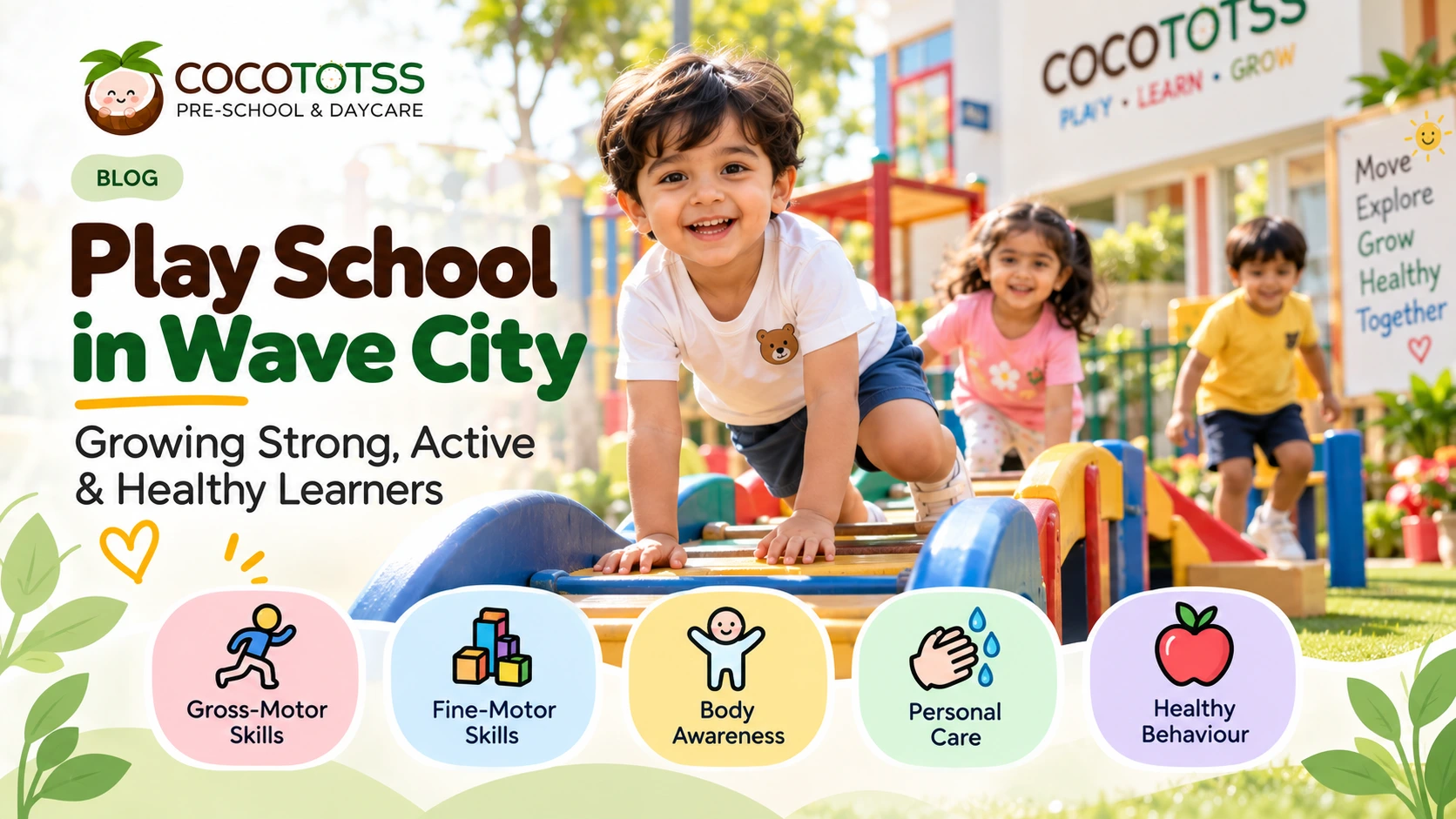
Choosing the right Play school in Wave City is about more than finding a place where children can spend their day. The early years are an important time for physical growth, movement, coordination, healthy habits, confidence and independence. At CocoTotss Preschool & Daycare, our Physical Development & Health curriculum gives children opportunities to move, play, explore and develop age-appropriate self-care skills in a caring learning environment.
Our approach focuses on five important areas:
- Gross-Motor Skills
- Fine-Motor Skills
- Body Awareness
- Personal Care
- Healthy Behaviour
Through active play, movement, games and age-appropriate physical activities, children can strengthen their bodies while also developing important skills for everyday life.
The National Curriculum Framework for the Foundational Stage recognizes physical development as an important part of early childhood learning. It highlights gross and fine motor development, physical movement, healthy eating, hygiene, safety and coordination as important areas during the Foundational Stage. NCERT
At CocoTots, physical development is therefore not treated as a separate activity that happens only during outdoor play. Movement, coordination, self-care and healthy habits can become part of a child’s everyday learning experience.
What Is Physical Development in Early Childhood?
Physical development is the way children gradually learn to control and use their bodies.
For a young child, physical development can include learning how to:
- Run
- Walk
- Jump
- Climb
- Balance
- Throw
- Catch
- Draw
- Hold a pencil
- Use scissors safely
- Build with blocks
- Wash hands
- Eat independently
- Put away personal belongings
These skills may look simple to adults, but they require practice and coordination.
A quality Play School Wave City environment can provide many opportunities for children to develop these abilities through play and daily routines.
The National Curriculum Framework states that children at the Foundational Stage learn strongly through the use of their senses and whole body in playful activities. It also emphasizes exercise, coordination of different muscle groups, healthy eating and hygiene habits. NCERT
Why Physical Development Matters at a Play School
Young children are naturally active.
They want to move, explore, touch, climb, carry, build and discover.
Instead of asking children to remain still for long periods, early education can use movement as part of learning.
The NCF for Foundational Stage says that play is central to learning and development and that outdoor play should be actively encouraged. It also notes that classroom activities should encourage gross and fine motor skills and physical movement. NCERT
Physical activity can support several areas of development at the same time.
When children run and jump, they practice body control.
When they draw and build, they practice hand control.
When they balance, they learn to coordinate their movements.
When they learn to wash their hands or manage their belongings, they practice independence.
This makes physical development an important part of holistic early education.
Our Physical Development & Health Curriculum
At CocoTots, our curriculum focuses on helping children become strong, active and healthy through meaningful age-appropriate experiences.
The five core areas are:
- Gross-Motor Skills: Large body movements such as running, jumping, climbing and balancing.
- Fine-Motor Skills: Small movements using hands and fingers, such as drawing, cutting, holding and building.
- Body Awareness: Understanding the body, movement, space, balance and physical abilities.
- Personal Care: Learning age-appropriate routines related to hygiene, eating, dressing and personal belongings.
- Healthy Behaviour: Developing healthy habits related to movement, food, cleanliness, rest and everyday well-being.
These areas are connected. A child may use gross-motor skills during outdoor play and then use fine-motor skills during an art activity.
Gross-Motor Skills: Learning Through Big Movements
Gross-motor skills involve the larger muscles of the body.
Children develop these skills through activities such as:
- Running
- Jumping
- Hopping
- Climbing
- Walking
- Balancing
- Throwing
- Catching
- Kicking
- Dancing
- Outdoor games
At a Play school in Wave City, these activities can turn physical movement into an enjoyable learning experience.
For example, an outdoor obstacle course can ask children to:
- Walk along a line.
- Jump over a soft obstacle.
- Crawl through a tunnel.
- Walk around cones.
- Throw a ball into a target.
The activity can be fun while also giving children opportunities to practice balance, coordination, direction and body control.
NCERT’s Foundational Stage framework includes physical play such as movement, balancing, outdoor play and games as examples of developmentally appropriate play experiences. NCERT
Fine-Motor Skills: Building Strong Hands and Fingers
Fine-motor skills involve smaller movements of the hands and fingers.
These skills are important for many everyday activities.
Children may practice fine-motor control through:
- Drawing
- Colouring
- Painting
- Puzzles
- Blocks
- Clay
- Threading activities
- Peg activities
- Turning pages
- Using age-appropriate tools
- Simple craft work
For example, when a child picks up a small block and places it carefully on a tower, the child is practicing hand control.
When a child uses crayons to draw, the child is learning to control hand and finger movements.
When a child works with clay, they can squeeze, roll, press and shape the material.
NCERT also gives examples such as clay activities as opportunities that can support both gross and fine motor abilities. NCERT
These activities can make learning more active and enjoyable.
Body Awareness: Understanding How the Body Moves
Body awareness means helping children understand their bodies and how they move.
Young children gradually learn:
- Where different body parts are
- How their body moves
- How much space they need
- How to balance
- How to move safely
- How fast or slowly they can move
- How to control their movements
Music and movement activities can be useful for this.
A teacher might ask children to:
“Touch your toes.”
“Raise your hands.”
“Walk slowly.”
“Jump like a frog.”
“Move like a butterfly.”
Such activities can help children connect instructions with body movement.
They also add fun to the classroom.
Personal Care: Learning to Look After Yourself
Physical health is not only about exercise.
Children also need to learn age-appropriate self-care skills.
At preschool, children can gradually practice routines such as:
- Washing hands
- Using tissues
- Keeping belongings in the right place
- Drinking water
- Eating independently where appropriate
- Cleaning up after activities
- Using the washroom with age-appropriate support
- Wearing or managing simple personal items
- Following basic safety instructions
These routines can help children become more independent.
A teacher does not need to do everything for a child.
Instead, children can be encouraged to try age-appropriate tasks while receiving support when needed.
This helps create a balance between independence and guidance.
Healthy Behaviour: Building Good Habits Early
Healthy habits often begin with simple daily routines.
Children can learn that taking care of their bodies includes:
- Moving regularly
- Eating nutritious food
- Drinking water
- Washing hands
- Keeping themselves clean
- Getting enough rest
- Playing safely
- Listening to their bodies
A preschool can reinforce these ideas through daily routines and classroom conversations.
For example, before eating, children can practice handwashing.
After outdoor play, teachers can guide children through simple clean-up routines.
During a conversation about food, children can learn about different fruits, vegetables and healthy choices in an age-appropriate way.
The goal is not to make children memorize health rules.
The goal is to help healthy actions become familiar habits.
Active Play and Learning
Play is one of the most natural ways for young children to learn.
The Ministry of Education and NCERT emphasize play-based, activity-based and experiential approaches for the Foundational Stage. The NCF describes play as free, guided or structured and encourages activities involving movement, music, games, toys, outdoor play and exploration. NCERT
At CocoTots, active play can support learning in many ways.
For example, a simple ball game can involve:
- Physical development: kicking, throwing and catching.
- Mathematics: counting throws or objects.
- Language: following instructions and describing actions.
- Social development: taking turns and cooperating.
- Emotional development: handling excitement and disappointment.
- This shows why physical development can connect with many other parts of a child’s learning journey.
Outdoor Play at a Play School Wave City
Outdoor play gives children opportunities to move their bodies and experience different types of physical activity.
Depending on the activity and available facilities, outdoor experiences can include:
- Running games
- Ball play
- Balance activities
- Climbing
- Slides
- Movement games
- Group activities
- Nature exploration
- Simple obstacle courses
Outdoor play can also give children opportunities to interact with classmates.
They may learn to wait for a turn, follow a simple rule, share space and communicate with friends.
The NCF specifically encourages outdoor play as part of foundational learning. NCERT
Physical Development Builds Confidence
A child’s physical progress can also affect confidence.
Think about a child who is learning to balance.
At first, the child may need support.
After practice, the child may be able to walk across a balance line independently.
That small achievement can create a sense of:
“I can do it.”
The same can happen when a child:
- Learns to catch a ball
- Completes a puzzle
- Builds a tall block tower
- Uses scissors safely
- Climbs a play structure
- Finishes a movement activity
These moments can help children see themselves as capable learners.
Movement and Cognitive Learning
Physical activity and learning are not separate worlds.
Children can use movement while learning numbers, language, shapes and concepts.
For example:
Counting Through Movement
“Jump five times.”
Learning Directions
“Walk forward.”
“Turn left.”
“Move behind the cone.”
Learning Shapes
“Can you find the circle?”
Learning Colours
“Run to the red marker.”
Learning Rhythm
“Clap slowly.”
“Clap quickly.”
These activities can help children connect physical experiences with ideas.
NCERT’s Foundational Stage framework notes that physical development and movement can also support socio-emotional and cognitive development. NCERT
Fine-Motor Activities for Preschool Children
Fine-motor development can be supported through many simple activities.
- Drawing and Colouring: Drawing gives children an opportunity to practice hand control while expressing ideas.
- Building Blocks: Blocks encourage children to pick up, place and connect objects.
- Clay Activities: Children can roll, press, squeeze and shape clay.
- Puzzles: Puzzles encourage children to hold, rotate and place pieces carefully.
- Threading: Age-appropriate threading activities can support finger coordination.
- Simple Art and Craft: Tearing, pasting and arranging materials can give children more opportunities to practice hand movements.
These activities should always be selected according to the child’s age and abilities.
Gross-Motor Activities for Preschool Children
A good Play School in wave city ghaziabad environment can include many age-appropriate movement experiences.
Some examples include:
- Jumping Games: Children can jump over soft lines or markers.
- Balance Games: Children can walk along a safe line or balance path.
- Ball Games: Children can roll, kick, throw and catch balls according to their developmental level.
- Music and Movement: Children can dance, march and move to songs.
- Obstacle Courses: Simple obstacle courses can combine walking, crawling, stepping and jumping.
- Outdoor Exploration: Children can walk, observe nature and move through safe outdoor spaces.
The focus should be on participation, practice and enjoyment rather than competition.
Why a Play School Should Support Healthy Habits
Early childhood is a time when children are learning daily routines.
A school can reinforce healthy habits through consistent practice.
For example:
Before food → Wash hands
After activities → Clean up
During outdoor play → Move safely
During meals → Practice healthy eating habits
During classroom routines → Drink water when appropriate
Small routines repeated over time can become familiar behaviours.
Parents and schools can work together to support these habits.
The Role of Teachers in Physical Development
Teachers play an important role in creating safe and positive physical experiences.
A teacher can:
- Demonstrate movements
- Explain simple safety rules
- Encourage children to participate
- Adapt activities when needed
- Offer age-appropriate support
- Observe children’s progress
- Encourage effort
- Give children time to practice
Every child develops at a different pace.
NCERT emphasizes that developmental learning outcomes should be viewed as a continuum and that children do not all reach developmental outcomes at exactly the same time. NCERT
This is important because physical development should not become a competition.
The goal is to encourage each child.
Every Child Learns at Their Own Pace
One child may run confidently while another may prefer walking.
One child may enjoy climbing while another may feel unsure.
One child may quickly learn to use a pencil while another needs more practice.
These differences are normal.
A supportive Play school in Wave City should provide opportunities without making children feel pressured.
Teachers can encourage children to participate at a level that is suitable for them.
The NCF also states that every child learns at their own pace and that learning needs should be addressed individually. NCERT
What Parents Should Look for in a Play School
If you are searching for Play school in wave city near me, consider more than the school’s distance from your home.
During a school visit, ask about:
- Physical Activity: What types of movement and outdoor activities are offered?
- Safety: How are children supervised during physical activities?
- Indoor Activities: Are there opportunities for fine-motor development?
- Outdoor Space: Do children have a suitable area for active play?
- Self-Care: Are children encouraged to develop age-appropriate independence?
- Healthy Habits: How does the school encourage hygiene and healthy routines?
- Teacher Support: How do teachers support children who develop skills at different speeds?
These questions can help parents understand the school’s approach.
Why CocoTots Focuses on Physical Development & Health
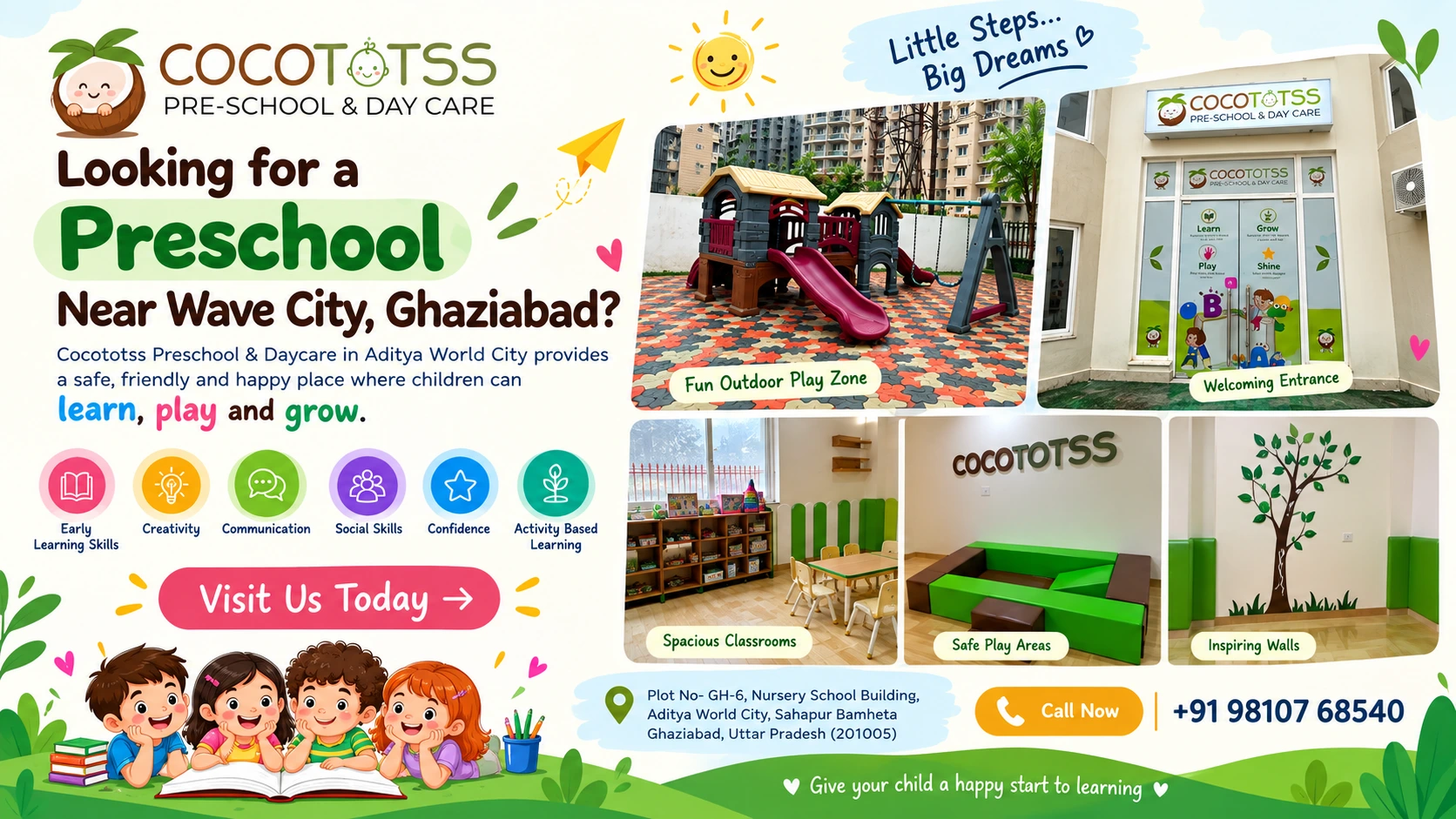
CocoTots Preschool & Daycare describes its learning approach as combining play, activities, exploration, creativity, social interaction and age-appropriate academics. The school is located in Aditya World City, Ghaziabad. CocoTots Preschool & Day Care
Its current programs include Play Group, Pre-Nursery, Nursery and other early learning stages, along with daycare options. CocoTots Preschool & Day Care
The broader CocoTots curriculum includes:
- Approaches to Learning
- Social & Emotional Development
- Physical Development & Health
- Language, Literacy & Communication
- Mathematics
- Science & Technology
- Creative Arts
- Social Studies
Physical development therefore forms part of a wider approach to early childhood learning.
You can explore the school’s Programs to understand the current program options. CocoTots Programs
Play School in Wave City for Growing Independence
Physical development and independence often go together.
When children learn to:
- Carry their own bag
- Put toys away
- Wash their hands
- Eat with age-appropriate independence
- Put materials back
- Follow simple movement routines
they are developing both physical and life skills.
These small actions can make children feel more capable.
A play school does not need to rush this process.
Children need time, encouragement and repeated practice.
Play School in Wave City Near Me: What to Ask About Fees
Parents often search for phrases such as:
Play school near me ghaziabad with fees
Play School near me with fees
Cocototss play school fees
Fee information is important when comparing schools, but online figures can become outdated.
CocoTotss’ FAQ explains that parents should contact the admissions team for current information about fees and admission details. CocoTotss Preschool & Day Care
Parents can contact the school directly:
Phone: +91 9810768540
Email: admission@cocototss.com
You can also use the CocoTotss Contact page for current contact and admission information. CocoTots Contact Us
Cocototss Wave City Reviews
Parents searching for Cocototss Wave City reviews can use online reviews as one source of information, but a school visit can provide additional context.
When visiting, parents can observe:
- Classroom environment
- Teacher-child interaction
- Activity spaces
- Outdoor areas
- Cleanliness
- Safety practices
- Learning materials
- Daily routines
This allows each family to decide whether the environment fits their child’s needs.
You can also read the school’s Frequently Asked Questions before planning a visit. CocoTotss Preschool FAQs
School in Wave City, Ghaziabad: A Holistic Learning Approach
Families searching for a School in Wave City, Ghaziabad may be looking for a school that supports more than early academic skills.
A child’s early years involve many areas of growth.
Children are learning:
How to move.
How to communicate.
How to make friends.
How to solve problems.
How to care for themselves.
How to understand the world around them.
That is why a balanced curriculum can combine physical, social, emotional, language, mathematical, creative and exploratory experiences.
CocoTotss’ current website describes its environment as safe, nurturing and engaging, with learning through play, exploration and meaningful activities. CocoTotss Preschool & Day Care
How Parents Can Support Physical Development at Home
Parents do not need expensive equipment to support physical development.
Simple activities can be enough.
- Encourage Outdoor Movement: Let children walk, run and play in safe spaces.
- Play Ball Games: Rolling, kicking and catching are simple ways to practice coordination.
- Try Music and Movement: Put on a child-friendly song and encourage children to move with the rhythm.
- Offer Drawing Activities: Crayons, paper and age-appropriate drawing tools can support fine-motor development.
- Let Children Help: Simple tasks such as putting toys away can build independence.
- Practice Healthy Routines: Encourage handwashing, hydration, healthy food choices and appropriate rest.
- Limit Long Periods of Sitting: Balance quiet activities with movement.
The goal is not to create a formal exercise routine for a preschool child. It is to make healthy movement a natural part of everyday life.
Physical Development and School Readiness
Physical development can also help children prepare for future classroom experiences.
Fine-motor control can support activities such as writing, drawing and using classroom materials.
Gross-motor development can support safe movement around school.
Body awareness can help children understand personal space and movement.
Personal care can support greater independence.
Healthy habits can help children understand how to care for themselves.
This is why physical development should be viewed as part of overall school readiness rather than as a separate subject.
Frequently Asked Questions (FAQ) AboutPlay School in Wave City
It means helping children develop movement, coordination, strength, body awareness, self-care skills and healthy habits through age-appropriate experiences.
Gross-motor skills involve large body movements such as running, jumping, climbing, balancing, throwing and kicking.
Fine-motor skills involve smaller hand and finger movements used for drawing, building, puzzles, craft and other everyday activities.
Yes. Physical Development & Health is one of the curriculum areas presented by CocoTotss, alongside social-emotional, language, mathematics, science, creative arts and other areas of development.
The current CocoTotss contact number listed on its website is +91 9810768540. CocoTotss Preschool & Day Care
Parents can contact the admissions team for current information about program fees, daycare, transport and other services. The school's FAQ advises parents to contact the school for current fee information. CocoTotss Preschool & Day Care
Yes. CocoTotss' current website describes the preschool as being located in Aditya World City, Ghaziabad, and its FAQ describes the campus as being in Wave City, Ghaziabad. CocoTotss Preschool & Day Care
Growing Strong, Active and Healthy at CocoTotss
A child’s physical development is about much more than running and jumping.
It includes learning how to control movements, use hands and fingers, understand the body, care for personal needs and develop healthy daily habits.
At CocoTotss, our Physical Development & Health curriculum brings these areas together through active play, movement, games and age-appropriate activities.
The five focus areas—Gross-Motor Skills, Fine-Motor Skills, Body Awareness, Personal Care and Healthy Behaviour—give children opportunities to build important skills while enjoying their early learning years.
For families searching for Play School in Wave City, Play School in wave city ghaziabad, Play school in wave city near me, or Cocototss Pre school Ghaziabad, it is worth looking beyond academics and asking how a school supports the whole child.
At CocoTotss Preschool & Daycare, the aim is to create a warm learning environment where children can move, play, explore, learn and grow. Visit CocoTotss Preschool & Daycare
Recent Post
-
 06 Oct 2026Playschool & Day Care in Wave City: 10 Powerful Skills
-
03 Oct 2026Play school in Wave City: 5 Powerful Ways to Grow
-
 22 Sep 2026Play School in Wave City: 8 Powerful Social Skills
-
 12 Sep 2026Pre Nursery in Wave City: Inspiring Curious & Independent Learners
-
 07 Sep 2026Preschool in Wave City
Near By Area
- Preschool in Aditya World City
- Preschool in Wave city
- Daycare in Wave City
- Daycare in Aditya World City
- Play Group in Wave City
- Play Group in Aditya World City
- Pre-Nursery in Aditya World City
- Nursery in Aditya World City
- LKG in Aditya World City
- UKG in Aditya World City
Contact us at:
- 9810768540
- Addmission@cocototss.com
- Plot No- GH-6, Nursery School Building, Aditya World City, Sahapur Bamheta Ghaziabad, Uttar Pradesh (201005)

One Response